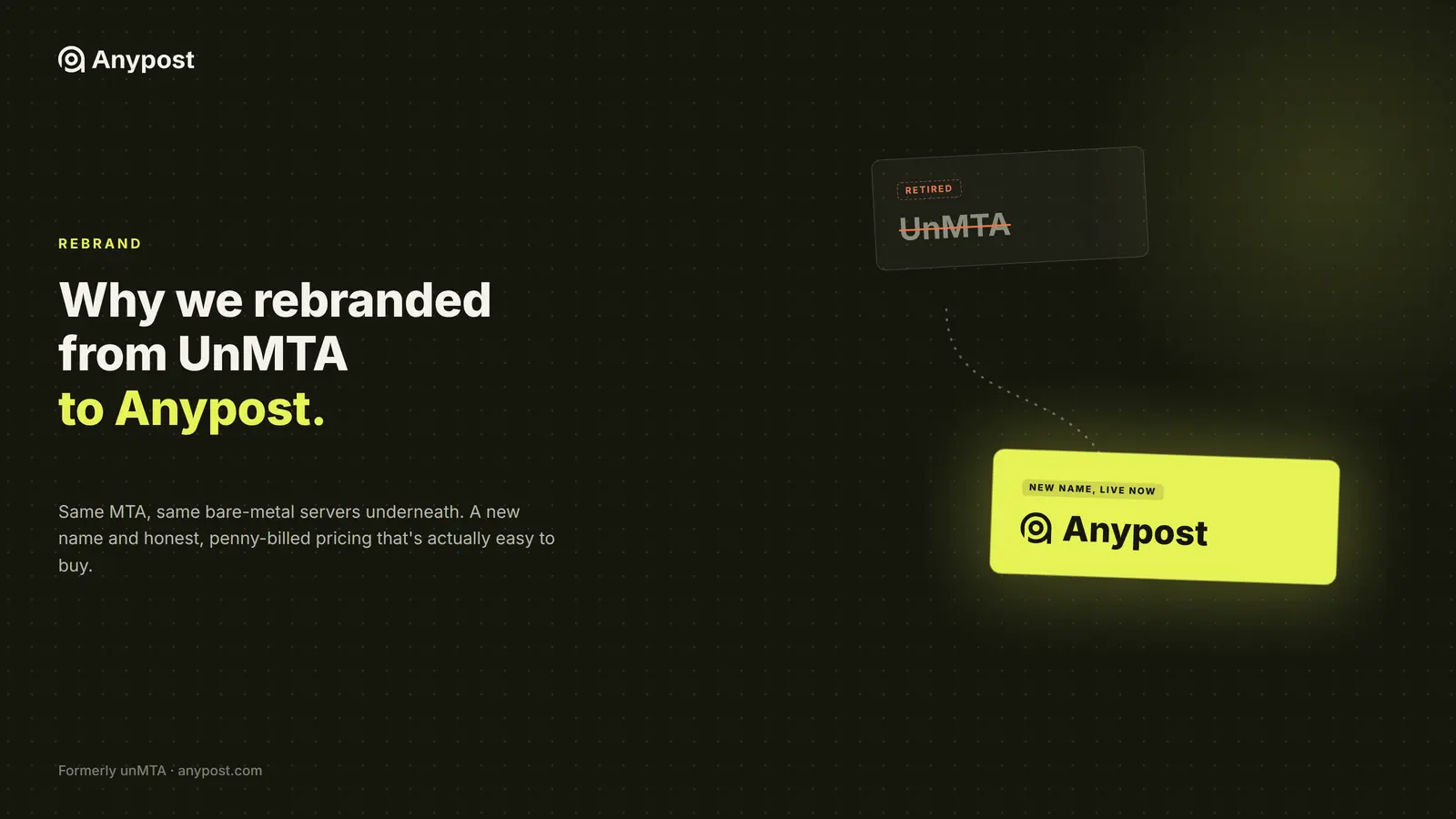
Before we launched Anypost you might have seen or read about a punchy startup called unMTA, revving to take on the established email infrastructure providers. We fancied ourselves disruptors, aiming to bring transparency and cost savings to a market saturated with hidden fees, gigantic platforms, and the ridiculous CPMs endemic to the big cloudy cloud providers.
We launched our product. It worked! Yes! Crack the champagne! But being good stewards and product developers, we listened to our community, our critics, and our friends, and realized that what we built was not necessarily what the market needed today.
What we got right
The technology. Full stop. Our MTA is lightning fast, capable of meeting the demands of the largest platform by delivering highly critical transactional email while providing the batch capabilities marketers need to run their campaigns and commercial messages.
unMTA was built to be fast because there is nothing worse than a password reset stuck behind 10 million time-sensitive offers that expire in four hours. In truth both need to be sent as quickly as possible, but the impact and relative importance of a password reset has to take priority. If that reset does not arrive, you just lost the attention of a customer who now has no reason not to go look at your competitor.
unMTA is intelligent, and comes prepackaged with everything you need to set up your email authentication to comply with Gmail's Bulk Sender Guidelines and the numerous other requirements we collectively call the best practices of sending email.
We even went the extra mile and built emailmd for marketers, and really for anyone who is forced to write HTML and wants it to come out clean, sophisticated, and modern. emailmd turns markdown into HTML, and being the community-minded bunch we are, we figured we would open source it so everyone can benefit from the solution we crafted to a problem that has dogged us across different platforms and companies.
We covered all the bases, right?
What we got wrong
Our thinking was that if we build something that really gets the technology right, then like a Field of Dreams, they (the customers) will come. We were kind of right. Here is where we get honest: we built the product and positioned it for the players on the field. Another way of saying the same thing is that we were too inside baseball. What we did not do was ask who is actually buying the product, and whether our positioning, pricing, and packaging required too much mental gymnastics to stack us against a competitor.
The answer to that question led us to Anypost. unMTA was built and sold on bandwidth and throughput, on capacity and other factors. If you are shaking your head, I do not blame you. Zoom out and unMTA was positioned for IT buyers, the people who deal in low-level metrics and stare at digital gauges on their public cloud accounts with the goal of keeping costs at bay. By trying to change how email is bought and priced, we lost sight of who needs to be excited by our product, and how to turn that excitement into a sale.
Where we landed
If you force your customers to invent their own calculator to compare your product against your competitors, because your pricing is a kind of higher-level math, then you have already lost. We spent weeks discussing our existing pricing, how it had to change, and how to turn the top of the funnel into sales at the bottom. The conversation was pretty straightforward: event pricing, or more accurately CPMs. We were all feeling good about this course. We could retire the spreadsheet calculators we were building to help people understand how unMTA could save them money.
When we looked at our costs running on bare metal versus giant cloud deployments, we realized the cloud tax was a material driver of our competitors' CPMs. By pricing and packaging unMTA on the same metric everyone else uses, we could offer savings large enough that choosing us would be a no-brainer. Crack the champagne!
Or so we thought. Once we nailed the pricing and started thinking about what to charge for IPs, something kept coming up that we really did not want to address: the name. Quick show of hands, how many of you reading this knew what an MTA was without searching for it? No cheating. Our name was so obscure that aside from the folks who live and breathe SMTP like Cheerios in the morning, nobody had any clue what it meant. The next step was clear.
We chose Anypost because it is mail-centric. Postmasters, postal mail, email: all of these more common phrases align like a cosmic conjunction around Anypost. And since you can send over SMTP or HTTP, you really can send your post any way you want to, or more importantly, in the way that makes the most sense for your business.
What we learned
This is not our first rodeo, and that simple fact cuts both ways. On the one hand, we were pretty cocky going into this. Collectively we have 50+ years of email experience. We have seen it all, built things, broken even more, and watched the world change while email remains the most foundational channel on the internet.
Where we fell down was in skipping the kind of buyer persona analysis that is a critical part of determining how you package and price yourself. If you do not know who you are trying to sell to, and we thought we did, then your pricing may end up too far afield to make the buying decision a simple one. If your branding is too eccentric, you will spend more time explaining what your name means than talking about what you can do for your customer.
In grade school we all learned the acronym KISS, and I am not talking about Gene Simmons. Keep It Simple, Stupid. I remind myself of this all the time. Simplicity is the first step to elegance, and in a world of messy technology, the elegance of simple, honest pricing, a package that makes sense for different buyers, and a humanized brand are crucial to the success of any startup.
We spent some time coming up with a tagline that summarized our vision and how we want people to see our little company:
A modern email platform, humanity included.
Built for the modern sender. Backed by actual humans. Billed by the penny.
Now that you have made it this far, come say hello and tell us what you think. We would love to hear from you.