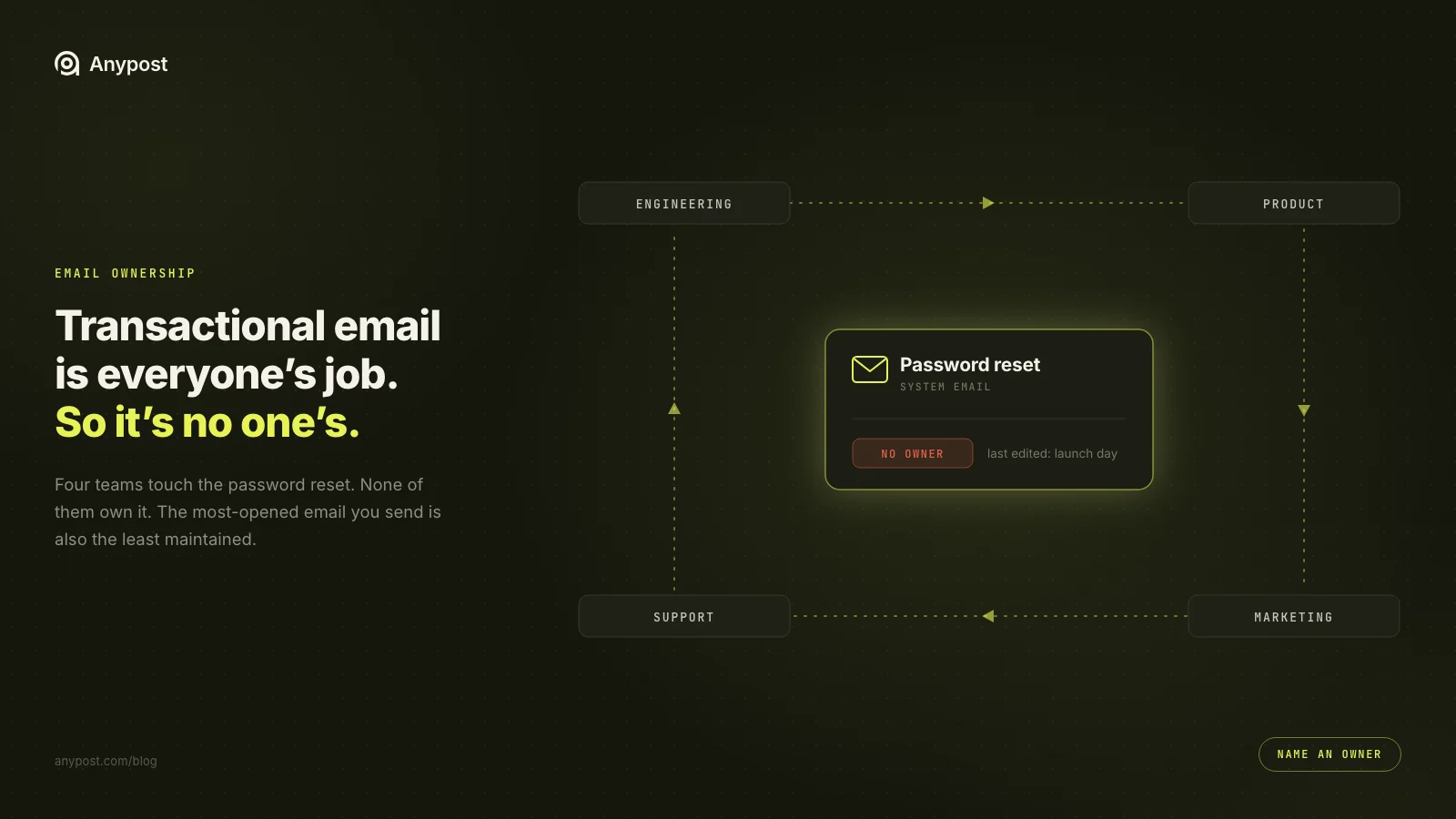
I spent 25+ years in SaaS, working sales, marketing, and support. And if you want to know which email nobody at a software company owns, I'll save you the org chart. It's the password reset.
Not the newsletter. Not the product launch campaign. Those have owners, calendars, and a team that argues about subject lines. I mean the emails that fire because a customer did something: signed up, reset a password, paid an invoice, got invited to a workspace.
Those are your transactional emails. They get opened more than anything marketing sends. And in most SaaS companies I've worked with, they're the most neglected emails in the building.
Here's why that happens, and what it costs you.
Problem #1: Coordination (four teams, zero owners)
Ask a SaaS team who owns transactional email and watch everyone point at someone else.
- Engineering built the trigger, so they think it's done.
- Product wrote the first draft of the copy two years ago.
- Marketing owns the brand but doesn't have access to the templates.
- Support hears about it when a customer says "I never got the email."
Everyone touches it. Nobody owns it. So when something needs to change, like a new logo, a new pricing page, or a confusing line in the welcome email, it turns into a Slack thread, then a Jira ticket, then a backlog item that sits for three sprints.
I saw this from every seat I held. In support, I was the one fielding "where's my reset link?" tickets. In marketing, I was the one asking engineering for a copy change and getting a polite "we'll get to it."
Problem #2: Design (the afterthought email)
Your marketing emails go through design review, brand review, and a round of testing across inboxes. Your receipt email? Somebody's developer built it in an afternoon with inline styles and a prayer.
That's how you end up with a gorgeous website, a polished newsletter, and a password reset that looks like it came from 2009. Or worse, one that breaks in Outlook, ignores dark mode, and has no plain-text version.
Here's the thing people miss. Customers don't separate "marketing email" from "system email." It all comes from you. Every one of those messages is a brand touchpoint, and the transactional ones are the touchpoints people actually read, because they asked for them.
Problem #3: Execution (a code deploy to fix a typo)
In a lot of SaaS products, transactional templates live inside the codebase. That means changing one sentence requires a developer, a pull request, a review, and a deploy. Nobody wants to burn engineering time on copy, so the copy never changes.
Then there's the stuff you can't see until it breaks:
- Deliverability. Transactional mail often shares a sending domain or IP with bulk marketing. One aggressive campaign hurts your reputation, and now your password resets are landing in spam.
- Authentication. SPF, DKIM, and DMARC set up once, years ago, by someone who has since left the company.
- Visibility. No one's watching bounce rates or delivery times on system email, so problems show up as support tickets instead of alerts.
A marketing email that lands in spam is a missed opportunity. A password reset that lands in spam is a locked-out customer, a support ticket, and sometimes a churned account.
What good looks like
The teams that get this right do a few simple things:
- Name an owner. One person or team is accountable for transactional email, end to end.
- Get templates out of the codebase. Engineering owns the trigger. Marketing and product own the words and the design.
- Separate your streams. Keep transactional sending apart from bulk marketing so one bad campaign can't lock customers out.
- Design and test it like it matters. Same brand standards, same inbox testing, same dark mode check as your campaigns.
- Watch the numbers. Delivery, bounces, and latency on system email, before support tells you something's wrong.
That's the problem Anypost was built to solve. It gives SaaS teams a dedicated home for transactional email, so engineering can wire it up once and everyone else can stop filing tickets to change a sentence.
If your password reset hasn't been touched since the day it shipped, go look at it today. Then take a look at Anypost.
What's the most neglected email in your product?